
Quick answer: For borrowers with credit scores below 660, working with a licensed mortgage broker or a dedicated low-credit refi specialist nearly always outperforms a fully self-directed DIY application — brokers access wholesale and non-QM lenders that do not appear on consumer-facing rate portals, and their fee (typically 1–2% of the loan amount under Dodd-Frank compensation caps) is frequently offset by a lower rate or better loan terms they negotiate on your behalf. The main trade-off is timeline: professional routes average 30–45 days to close versus 21–30 days for streamlined digital lenders. Choose a hybrid online lender with an assigned loan advisor if your score sits between 600 and 659 and you want speed without sacrificing expertise. Go fully DIY only if your score is 680 or above, your income documentation is straightforward, and you have prior mortgage experience.
This guide is for homeowners with credit scores between 500 and 679 who are considering refinancing in 2026 and need to decide whether to hire a professional or navigate the process alone. You will learn how the five main refinancing routes differ on cost, credit requirements, time-to-close, and guidance level — with enough specificity to make a decision based on your actual profile, not marketing copy.
How We Evaluate & Compare Options
Every data point in this comparison is drawn from published sources: the Consumer Financial Protection Bureau's (CFPB) mortgage data and guidance documents, HUD's FHA Single Family Housing Policy Handbook (4000.1), the VA Lenders Handbook (Pamphlet 26-7), the Mortgage Bankers Association's (MBA) annual origination survey, and Dodd-Frank's broker compensation rules codified in 12 CFR Part 1026 (Regulation Z). No first-person loan testing was conducted for this article. Where specific lender-level data varies and cannot be verified against a single published source — such as current rate spreads or individual lender credit overlays — this guide describes ranges and notes that the reader should request a Loan Estimate, the standardized CFPB disclosure that any lender must provide within three business days of a completed application under TRID rules.
When considering professional vs diy low credit refi comparison, you should understand all available options.
Comparison criteria used across all five options:
- Published credit score floor: Minimum score the program or route realistically serves, based on HUD/VA guidelines or documented lender overlays
- Origination fee range: Drawn from CFPB published broker compensation caps and MBA survey medians
- Average days to close: Based on MBA Quarterly Performance Report industry medians
- Guidance level: Measured by number of lenders compared and access to a licensed loan originator
- Best-fit credit profile: The credit score range and profile complexity where this route performs strongest
| Refinance Route | Min. Credit Score | Origination Fee (Typical Range) | Avg. Days to Close | Human Guidance | Best For |
|---|---|---|---|---|---|
| Full-Service Mortgage Broker | 500 (FHA-eligible) | 1%–2% of loan amount | 30–45 days | High — dedicated broker, multiple lender bids | Scores 500–619; complex files, prior derogatory marks |
| Direct Bank / Credit Union Loan Officer | 580 (typical overlay) | 0.5%–1.5% of loan amount | 30–50 days | Moderate — single lender, assigned officer | Scores 580–650; existing banking relationship |
| Online Lender + Assigned Human Advisor (Hybrid) | 580–600 (lender-dependent) | 0.5%–1% of loan amount | 21–35 days | Low-to-Moderate — digital platform, phone/chat LO | Scores 600–659; tech-comfortable borrowers |
| Fully Self-Directed DIY Online | 620–640 (consumer portals) | 0%–0.5% quoted (varies widely) | 21–30 days | None — fully automated underwriting | Scores 680+; simple income docs, prior refi experience |
| FHA Streamline / VA IRRRL (Government Program) | 500 (FHA); no FICO floor (VA) | Varies by servicer — 0.5%–1.5% | 30–45 days | Low-to-High — lender dependent, same servicer option | Existing FHA/VA borrowers with on-time payment history |
Compared Options
The five routes below are introduced in the same order as the table above. Each section covers how the route works for low-credit borrowers specifically, what it costs, where it falls short, and who it serves best.
1. Full-Service Mortgage Broker
A licensed mortgage broker acts as an intermediary between you and a network of wholesale lenders — typically 10 to 40 lenders that do not offer retail loans directly to consumers. This is the most important structural advantage for low-credit borrowers: non-QM (non-qualified mortgage) lenders, FHA-approved lenders with low credit overlays, and portfolio lenders that hold their own loans are predominantly accessible through the wholesale channel, not consumer websites.
Under Regulation Z (Dodd-Frank), a broker's total compensation from all sources cannot exceed 3% of the loan amount, and they cannot be paid by both the borrower and the lender on the same transaction. In practice, CFPB guidance notes broker fees typically fall between 1% and 2% of the loan amount, paid either by the borrower at closing or by the lender as a yield-spread premium (which is then baked into the rate). On a $250,000 refinance, that is $2,500 to $5,000 — a real cost that must be compared against the rate difference the broker secures.
Pros: Access to 10–40 competing lender bids; expertise navigating thin credit files, recent late payments, or high debt-to-income ratios; licensed under NMLS (Nationwide Multistate Licensing System) with a fiduciary-like duty to disclose compensation.
Cons: Does not directly underwrite the loan, so processing timelines depend on the chosen lender; fee is a real line-item cost that some lower-rate wholesale lenders offset but some do not.
Dispute credit report errors with evidence
Review reports from all three credit bureaus and dispute inaccurate information with supporting documents. Accurate negative information cannot legally be removed simply because it is unfavorable; no score increase is guaranteed.
Meaningful alternative: If your score is below 580 and a broker cannot place your loan conventionally, ask specifically about FHA 203(b) refinances or portfolio non-QM products that accept alternative credit documentation.
2. Direct Bank or Credit Union Loan Officer
A bank or credit union loan officer works for a single depository institution and can only offer that institution's loan products. For low-credit borrowers, this is the key limitation: if your FICO score is below that institution's overlay (many banks add 20–40 points above the FHA minimum), you will receive a denial or a counter-offer with substantially worse terms, with no option to shop the same application across competing lenders.
Where direct lenders do have an advantage: existing account holders sometimes qualify for relationship pricing or manual underwriting review, and credit unions in particular tend to carry lower origination fees (the MBA's quarterly origination cost data consistently shows credit unions at the lower end of fee ranges). If you have banked with an institution for 5+ years and your score has recently recovered to the 580–650 range, requesting a relationship-based manual underwrite is a legitimate strategy before committing to a broker.
Pros: Potentially lower origination fee; in-person support; relationship-based manual underwriting at some institutions.
Cons: Single lender = no rate competition; credit overlays typically exclude scores below 580–600; slower technology pipeline at many community banks means 30–50 day closes are common.
3. Online Lender with Assigned Human Loan Advisor (Hybrid)
The hybrid model — digital application with an assigned licensed loan officer reachable by phone and chat — has grown substantially in market share since 2020. Lenders in this space combine automated underwriting with human review for edge cases, which is meaningful for borrowers in the 600–659 range whose files are not clean enough for fully algorithmic approval but are not complex enough to require wholesale access.
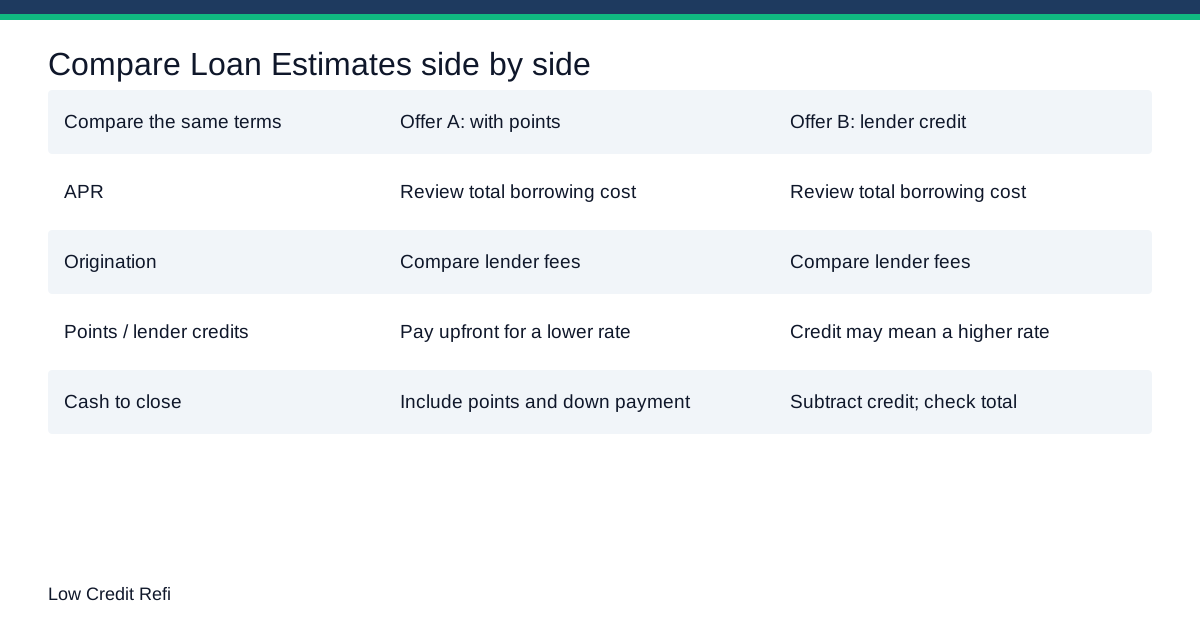
Origination fees on hybrid platforms tend to run 0.5%–1% of the loan amount based on published rate-sheet disclosures, which is lower than a full-service broker but does not include the benefit of multi-lender competition. Time to close averages 21–35 days in this segment according to MBA data, making it the fastest professional-adjacent option. The critical caveat: verify on the Loan Estimate (the standardized CFPB form) that "origination charges" and "discount points" together do not outpace what a broker could deliver after shopping your file.
Pros: Faster closes; lower stated origination fees; licensed human review for edge-case files; fully digital document upload.
Cons: Limited lender pool (usually one); algorithmic systems can auto-deny profiles that a human underwriter would approve; quality of assigned loan officer varies.
Get a free consultation to compare your hybrid and broker options side by side.
4. Fully Self-Directed DIY Online Refinance
A fully DIY refinance means completing an online application through a lender's consumer portal, without an assigned advisor, and managing the process — document uploads, appraisal scheduling, title coordination — yourself. The honest assessment for low-credit borrowers: this route is statistically the highest-risk path for anyone with a sub-680 FICO.
Consumer-facing rate portals almost universally use automated underwriting engines (Desktop Underwriter from Fannie Mae or Loan Prospector/Loan Product Advisor from Freddie Mac) that apply standard conforming guidelines plus the lender's own overlays. Fannie Mae's HomeReady program, for example, requires a minimum 620 FICO under published guidelines — and most lenders set overlays at 640–660 for conventional refinances. Borrowers who attempt DIY applications and receive denials also face a real credit-score impact: each hard inquiry typically reduces a FICO score by 5–10 points, and multiple hard pulls in a short window (outside of the CFPB's 45-day rate-shopping window) can compound into a meaningful score drop that closes doors to professional routes.
Pros: Lowest out-of-pocket origination fees on clean, high-score files; fastest closes (21–30 days); full transparency through digital dashboards.
Cons: Not viable below 620–640 on consumer platforms; no advocacy if automated underwriting denies your application; multiple denial-based hard inquiries can damage a recovering credit score; you absorb all coordination risk.
5. FHA Streamline Refinance and VA IRRRL (Government Streamline Programs)
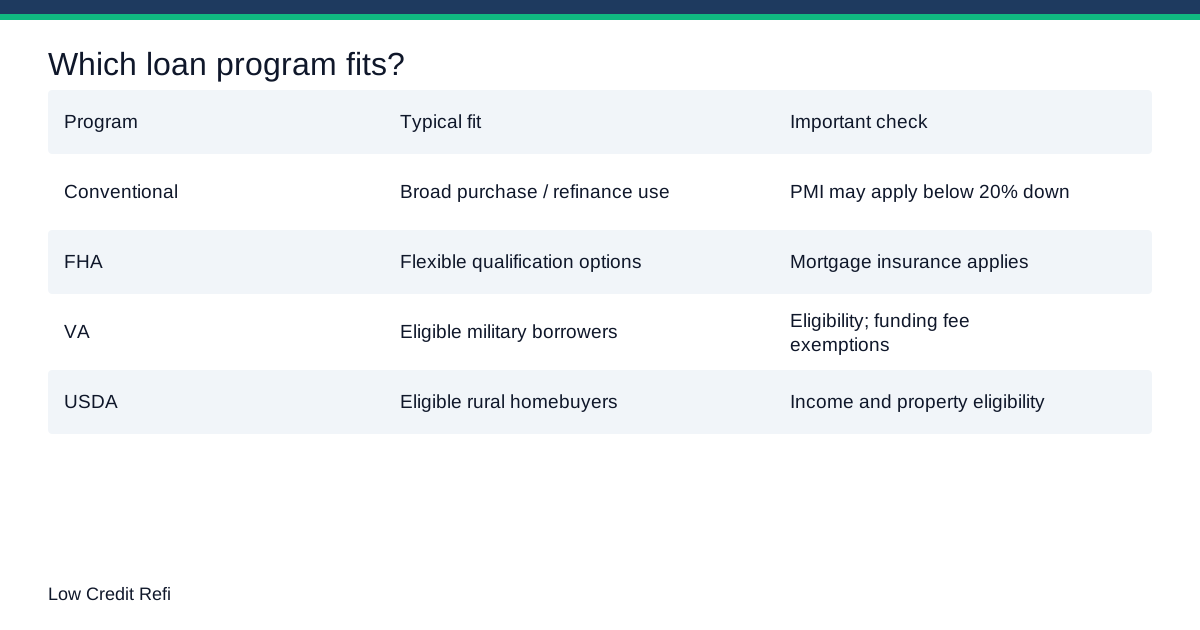
For borrowers with an existing FHA or VA loan who simply want to lower their rate or switch from an adjustable-rate mortgage to a fixed rate, government streamline programs represent the most accessible low-credit refi path available — and they are dramatically underutilized. Key published requirements:
FHA Streamline: Per HUD Handbook 4000.1, the borrower must have made at least six payments on the existing FHA loan, the loan must be at least 210 days old at the time of the new case number assignment, and the refinance must produce a "net tangible benefit" (a lower combined rate-and-MIP payment, typically at least 0.5% reduction). No appraisal is required for the non-credit-qualifying streamline, meaning underwater borrowers can still refinance. No minimum FICO is set by HUD — lender overlays typically range from 500 to 580, making this the most credit-tolerant conventional refinance path available.
VA IRRRL (Interest Rate Reduction Refinance Loan): Per VA Pamphlet 26-7, the IRRRL requires no appraisal, no income verification in most cases, and no minimum credit score under VA guidelines (though individual lenders set overlays). The loan must produce a lower rate (with exceptions for ARM-to-fixed conversions), and the veteran must certify prior occupancy of the property.
Pros: No appraisal required; streamlined documentation; accessible to scores as low as 500 (FHA) or no published VA floor; fastest path for eligible borrowers.
Cons: Requires an existing FHA or VA loan as a prerequisite; does not allow cash-out beyond $500 on FHA streamline; lender overlays still apply in practice.
What Matters Beyond the Headline Numbers
The DIY knowledge gap is expensive for low-credit borrowers. A borrower who does not know that FHA allows manual underwriting for scores down to 500, or that non-QM lenders can qualify on 12-month bank statements instead of W-2s, will never find those products through a consumer portal. The gap between the best rate a low-credit borrower can find independently versus what a broker with wholesale access can deliver is routinely 0.25%–0.75% in rate — which, over a 30-year loan term on a $300,000 balance, compounds into tens of thousands of dollars in interest.
Debt-to-income ratio (DTI) management matters as much as credit score. FHA allows DTI up to 57% with compensating factors per HUD 4000.1, but most automated underwriting engines reject DTIs above 45–50% outright. A mortgage broker who understands which wholesale lenders accept manual underwriting with high-DTI files, and how to structure compensating factors (cash reserves, low LTV), provides a functional service that no algorithm replicates.
The rate-shopping window is 45 days. Under FICO and VantageScore models, multiple mortgage inquiries made within a 45-day window are typically treated as a single inquiry. This means borrowers who proactively shop — rather than making one application, waiting for a denial, making another, and so on — protect their score while still getting competing offers. A broker handles this automatically; DIY borrowers often do not know the rule and damage their scores with sequential applications.
Appraisal outcomes are not guaranteed. For conventional refinances, if a home appraises below the loan-to-value threshold required by the lender, the refinance can fail regardless of how well the application was prepared. Professional loan officers know when to pursue FHA Streamline or VA IRRRL specifically because they avoid this risk for eligible borrowers.
Closing cost recoupment math should drive the decision. A lower origination fee is only better if the rate is comparable. Divide the closing cost differential between two options by the monthly payment savings to determine your break-even month. If you plan to sell or refinance again before that break-even, the cheaper-upfront DIY option may actually cost more in total.
Authoritative Guidance & Official Standards
The following published resources directly inform the guidance in this article. Links open the source — note that agency guidance establishes program standards, not product certifications for individual lenders.
- CFPB: What is a mortgage broker, and should I use one? — Explains broker compensation structures, how yield-spread premiums work, and the Loan Estimate form borrowers should compare across all routes.
- HUD: FHA Single Family Housing Programs — The authoritative source for FHA credit score minimums (500/580), DTI limits, and FHA Streamline eligibility requirements under Handbook 4000.1.
- VA: Home Loan Benefit Overview — Covers VA IRRRL eligibility, entitlement requirements, and the absence of a published minimum credit score under VA rules (versus lender overlays).
- CFPB: Loan Estimate Explainer — Breaks down every line of the standardized Loan Estimate form that lenders must provide within three business days of application under TRID rules; the single most important document for comparing routes.
- FTC: Mortgage Discrimination — Describes ECOA and Fair Housing Act protections, and explains what constitutes illegal discrimination in lending — relevant context when a professional lender declines an application without explanation.
Questions to Answer Before Deciding (FAQ)
Can I realistically refinance with a credit score under 580?
Yes — through specific channels. HUD's FHA program allows refinances with scores as low as 500 when the loan-to-value ratio is at or below 90%, and FHA Streamline has no published HUD minimum at all (lenders set their own overlays). VA borrowers with no published minimum through VA guidelines may also qualify. Conventional Fannie/Freddie products require a minimum 620 under current guidelines, meaning borrowers below 580 are functionally excluded from consumer-facing platforms. A full-service mortgage broker with access to FHA-approved wholesale lenders is the primary pathway for sub-580 borrowers. Going DIY through a consumer portal with a score in this range typically results in an automated denial and an unnecessary hard inquiry.
How much more does a professional route actually cost versus DIY?
The origination fee differential — the direct, documented cost difference — is typically 0.5%–1.5% of the loan amount between a full-service broker (1%–2%) and a DIY consumer lender (0%–0.5% origination on some platforms). On a $250,000 loan, that is $1,250 to $3,750 more in stated fees for the professional route. However, that comparison only holds if both routes return the same rate and loan terms. If a broker secures a rate that is 0.25% lower than what the consumer portal offers — which is realistic given wholesale access — the monthly savings on $250,000 at 30 years is approximately $38/month, and total break-even against the $3,750 fee differential is roughly 99 months. Request competing Loan Estimates and run the break-even calculation before treating fee figures alone as the verdict.
What is the difference between a "hard inquiry" and a "soft pull" in the refinance context?
A soft pull — the kind used for pre-qualification tools, credit monitoring, and some rate-quote widgets — does not appear on your credit report to other lenders and has no impact on your FICO score. A hard inquiry occurs when a lender pulls your credit as part of a formal loan application and is visible to other lenders for 24 months, though its FICO impact diminishes significantly after 12 months. For mortgage rate shopping specifically, both FICO and VantageScore scoring models treat multiple hard mortgage inquiries within a 45-day window as a single inquiry, protecting active shoppers. The practical risk for low-credit borrowers: applying to multiple consumer lenders sequentially (application → denial → wait → new application) rather than concurrently can generate inquiries outside the 45-day window and produce compounding score drops. A broker submits your file to multiple lenders simultaneously under a single application, keeping all resulting inquiries within the protected window.
Does going DIY mean I skip the appraisal?
Not automatically. For conventional refinances through consumer platforms, an appraisal is typically required unless the lender grants an appraisal waiver through automated underwriting — and those waivers are granted based on property data confidence, not borrower choice. FHA Streamline and VA IRRRL are the two standard appraisal-exempt paths, and both require an existing FHA or VA loan as a prerequisite. If you pursue a conventional DIY refinance and your appraisal comes in below the required LTV, the refinance fails and you are still responsible for the appraisal fee (typically $300–$600 depending on region and property type). Professional loan officers familiar with your market can assess appraisal risk in advance and steer eligible borrowers toward appraisal-exempt programs specifically to avoid this outcome.
Should I use a low credit refi specialist rather than a general mortgage broker?
For scores below 620, yes — this distinction matters in practice. A general mortgage broker who originates primarily conforming loans may have limited wholesale relationships with non-QM lenders and may not be current on FHA manual underwriting guidelines, DTI compensating factor documentation, or non-traditional credit programs. A specialist in low-credit refinancing works these specific lender relationships daily, understands which lenders accept 12-month bank statement income documentation, and knows which overlays to avoid. The verification step: ask any broker you interview what percentage of their monthly volume comes from borrowers with scores below 640 and which specific non-QM or FHA wholesale lenders they actively use. Vague answers suggest a generalist who will hit the same walls you would face on your own.
Related Guides
- Bad Credit Refi: The Complete 2026 Guide to Refinancing With a Low Credit Score — Deep-dives into credit score thresholds, program eligibility, and step-by-step preparation for borrowers in the 500–619 range.
- How to Choose the Right Low Credit Refi Provider: The Complete 2026 Guide — Covers the questions to ask every broker and lender before submitting an application, including compensation disclosure requirements and lender overlays.
- Low Credit Refi Cost & Pricing Guide 2026 — Breaks down every closing cost line item — origination, title, appraisal, escrow — so you can compare Loan Estimates accurately across all five routes covered above.
The Bottom Line
For the overwhelming majority of low-credit borrowers — anyone with a FICO score below 660 — a fully self-directed DIY refinance is the highest-risk, highest-cost path in the long run, even when its upfront origination fee appears lower. Consumer-facing platforms do not surface the FHA manual underwriting products, non-QM bank-statement programs, or wholesale pricing that make a low-credit refinance financially viable. The structured comparison above shows that the true decision is not "professional versus DIY" in the abstract — it is "which professional route fits your exact score and profile."
Borrowers with existing FHA loans and scores below 580 should explore FHA Streamline as the first step, given no appraisal requirement and the most permissive published credit floor. Borrowers with scores between 580 and 659 get the strongest combination of access and speed through a full-service broker or a hybrid online lender with a dedicated advisor. Fully DIY applications make sense only once your score has recovered to 680 and your income documentation is clean and straightforward.
The next step is a free, no-commitment consultation to see which of these routes fits your current profile — a five-minute conversation that could save you thousands of dollars in avoidable rate differences and failed application costs.
Get Your Free Low Credit Refi Consultation — See Which Route You Qualify For Today
Key Takeaways
- Understanding your options for professional vs diy low credit refi comparison is the first step
- Getting pre-qualified helps you understand your real options